
MASTERMIND / RULES, HISTORY AND STRATEGY
How to play Mastermind: feedback, repeats and useful guesses
Learn how black and white clues work, why repeated colours matter and how to choose informative guesses, with a complete feedback example.

Where the game came from
Mastermind comes from the tabletop tradition of cracking a secret code. The research paper Hardness of Mastermind dates the popular board game’s release to 1971. Publisher Hasbro still describes the roles of codemaker and codebreaker. In Rich Games, the bot chooses the secret while you keep the same task: extracting useful information from each guess.
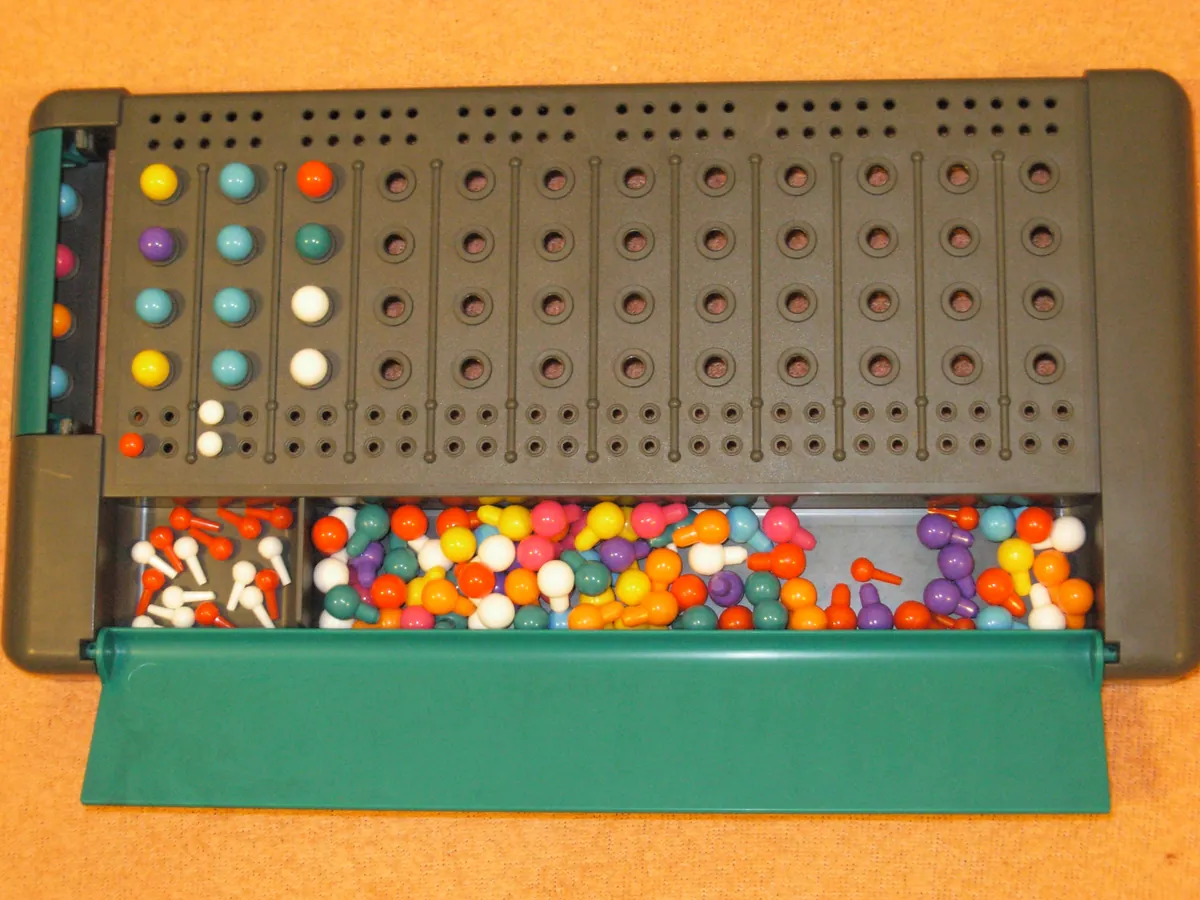
Loading the practice board…
Read the feedback correctly
A black dot ● means the right colour in the right position. A white dot ○ means the right colour in a different position. The order of the dots does not correspond to the order of your pegs. Feedback summarises the entire row, rather than labelling individual positions.
Colours can repeat in the secret. Each peg is counted once: exact matches are removed first, then the remaining colours are compared. Rich Games checks a completed row automatically. Before placing the final peg, you can remove the latest input using ⌫.
Choose guesses for information
After each answer, retain only codes that would produce exactly the same feedback for every previous guess. A new guess should help distinguish those remaining possibilities, rather than merely look slightly different from the last one.
It can help to identify the colours first and their positions next. However, the stages overlap: one guess often tests both composition and arrangement. If you change everything without a clear reason, comparing answers becomes harder.
Feedback with no dots excludes every colour used in that guess. When the total number of black and white dots equals the code length, you have identified the colour multiset, including repetitions, but may still need to determine its order.
Worked example: two black dots and two white dots
For this teaching example, let the secret be “red, blue, red, green” and the guess be “red, red, blue, green”. Positions one and four match exactly, giving two black dots. After removing those matches, red and blue remain in the wrong positions, giving two white dots.
The answer ●●○○ does not identify which two positions are correct. We know only because this example reveals the secret. In an actual game, compare several rows to establish that. The two red pegs in the guess are legal and provide meaningful information.
Common interpretation mistakes
Do not mentally attach a white dot to the peg next to it: no such correspondence exists. Do not rule out repeated colours, or some valid secrets become impossible for you to find. Do not count one secret peg twice just because a colour repeats in your guess.
Another common failure is submitting a code that contradicts an earlier answer. Before the final tap, check the proposed row against at least the strongest known restriction, such as a set of fully excluded colours.
Practise in Puzzles
Start with Easy: four positions, six colours and ten guesses. Medium keeps four positions and adds colours; Hard uses five positions. A larger possibility space makes consistent checking especially valuable.
After a game, recall the guess that removed the most uncertainty. Explain its value independently of how many black dots it produced. An informative move does not have to make your visible row look immediately more like the secret.
Sources and further reading
Another good read
 Puzzles
How to solve Sudoku: singles, hidden singles and steady progress
Learn Sudoku rules, the Number Place story and three practical solving techniques, with a worked example and a simple practice plan.
Read Puzzles
How to play Minesweeper: numbers, flags and safe deductions
Understand the eight neighbours, safe cells and overlapping regions. Includes Minesweeper history and a worked two-clue deduction.
Read Puzzles
How to solve nonograms: overlaps, gaps and picture logic
Learn nonogram history, block rules and the overlap technique with a worked example. Discover why empty cells matter as much as filled ones.
Read