
MANCALA / RULES, HISTORY AND STRATEGY
How to play mancala: Kalah, extra turns and captures
Learn Kalah rules, distinguish it from the wider mancala family and work through extra turns, sowing and captures.

Where the game came from
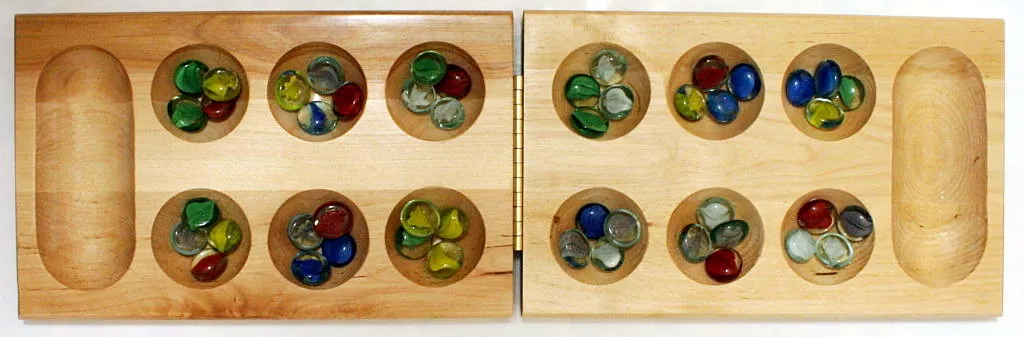
Mancala describes a family of games in which players sow counters into pits, rather than one unchanging rulebook. The British Museum collection includes an Indian pallankuli board, played with tamarind seeds, pebbles or cowrie shells. Similar-looking equipment therefore does not guarantee identical rules.
Rich Games uses Kalah: six pits per player, two stores, extra turns and captures from the opposite pit. This guide covers that version. Rules from Oware do not automatically apply, and the age of the wider mancala family should not be presented as the invention date of Kalah.
Loading the practice board…
What happens when you choose a pit
Pick up every stone from one of your nonempty pits and distribute them counterclockwise, one at a time. Include your own store and skip your opponent’s store. If the final stone lands in your store, you play again. A single turn can therefore contain several separate sowing moves.
If your last stone lands in an empty pit on your side, with stones in the opposite pit, both those stones and your last stone move into your store. When either side has no stones left in its pits, the other player collects the stones remaining on their side. The larger final store wins.
Count the distance to your store first
Before selecting a pit, count the steps from it to your store. If the number matches its stones, the move grants another turn, provided the sowing does not make a complete circuit. Recalculate afterwards: your first move has changed other pits and may have created another extra turn.
Next ask where the final stone will land and what sits opposite it. A capture can be worth more than depositing a single stone, but examine your opponent’s reply. Sowing also changes their pits; an attractive capture may set up an even larger one against you.
A worked extra-turn example
Label your six pits A–F from left to right, with your store immediately after F. On the opening 6×4 board each pit contains four stones. Choosing C places one stone in D, E, F and your store. C becomes empty, D–F each contain five, and your store contains one. You move again.
F now contains five stones, so do not calculate its next move as though it still contained four. Compare continuations from the updated position. For a separate capture example, imagine your final stone reaches your empty pit opposite four enemy stones. You collect five, including the final stone you just placed.
A lead in the store is not the whole score
Beginners often judge the position only by the displayed stores. Stones still on the board matter because one side collects its remaining stones at the finish. Before emptying your side, calculate both final totals, including that collection. Keeping one pit occupied may be better than ending the game immediately.
Practise in Telegram
Open mancala in Board Games and choose 6×3, 6×4 or 6×5: six pits with three, four or five starting stones each. Spend one game identifying extra turns, another spotting captures, then combine both ideas in a game with a friend. Keep checking the final landing pit before committing.
Sources and further reading
Another good read
 Puzzles
How to solve Sudoku: singles, hidden singles and steady progress
Learn Sudoku rules, the Number Place story and three practical solving techniques, with a worked example and a simple practice plan.
Read Puzzles
How to play Minesweeper: numbers, flags and safe deductions
Understand the eight neighbours, safe cells and overlapping regions. Includes Minesweeper history and a worked two-clue deduction.
Read Puzzles
How to solve nonograms: overlaps, gaps and picture logic
Learn nonogram history, block rules and the overlap technique with a worked example. Discover why empty cells matter as much as filled ones.
Read