
REVERSI / RULES, HISTORY AND STRATEGY
How to play Reversi: corners, mobility and flipping discs
Learn modern 8×8 Reversi rules, its relationship with Othello and practical ideas for corners, mobility and safer moves.

Where the game came from
Historical Reversi appeared in England in the 1880s. The World Othello Federation explains that original Reversi and modern Othello differed, including their opening arrangements and some rules. Today, “Reversi” often means the familiar version with four discs in a fixed central starting pattern.
Rich Games uses an 8×8 board, four starting discs in the centre and an automatic pass when no legal placement is possible. This guide covers those modern mechanics. The history of the names is useful context; the actual rules of your game determine the strategy.
Loading the practice board…
How flipping works
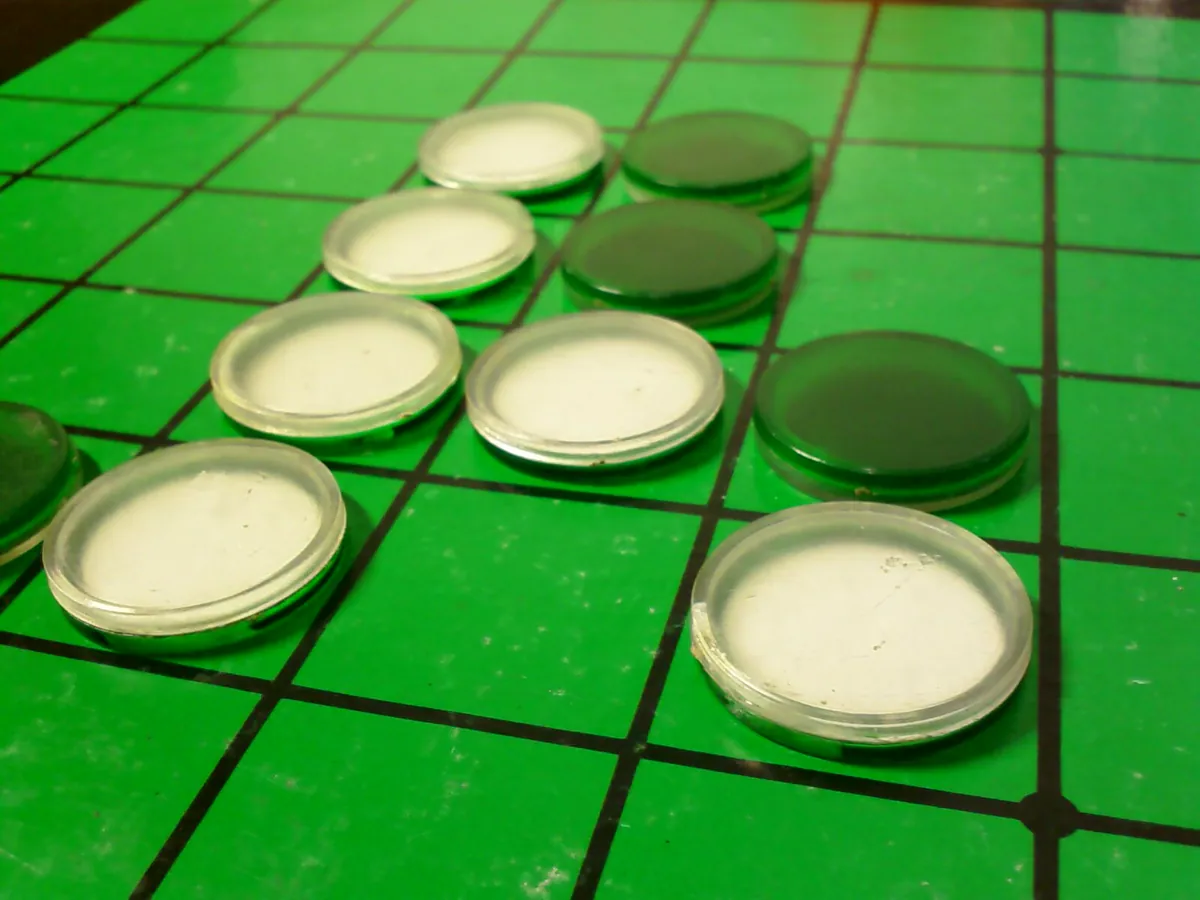
Your new disc must bracket at least one uninterrupted line of opposing discs between itself and an existing disc of your colour. Lines can run horizontally, vertically or diagonally. Every line bracketed directly by the new placement flips at once. You cannot jump over an empty square or one of your own discs.
If you have no legal move, your opponent plays again. The game ends when neither player can move, even if empty squares remain. Whoever has more discs on the board wins. A comfortable lead halfway through therefore does not settle the result.
Value mobility before early disc count
Mobility means the number of legal moves available. Compare moves by the choices they leave your opponent, as well as the discs they flip. A useful move often preserves your options while narrowing theirs. Having many discs alongside empty squares can instead give your opponent convenient lines to attack.
A corner cannot be flipped: the board ends before another disc could bracket it from beyond. Corners are therefore secure anchors. Squares beside an empty corner need care, especially its diagonal neighbour, which can offer the corner immediately. Treat this as a position to calculate, rather than an absolute prohibition.
Follow a complete flipping line
Consider one row in isolation. B4 holds a black disc, C4 and D4 hold white discs, and E4 is empty. Black may play E4: E4–D4–C4–B4 brackets the white discs, so C4 and D4 turn black. If B4 were white too, with no black anchor further along, that horizontal line would capture nothing.
Now imagine A1 is empty, your disc occupies B2 and an enemy disc occupies C3, with the relevant segment otherwise clear. Your opponent can play A1, bracketing your B2 against their C3. That is the concrete danger of a diagonal square next to a corner. Check this line and other replies before playing B2.
Why flipping the most can lose
A greedy move may leave you with a large group of unstable discs while giving away an edge. An edge is not automatically secure throughout: stability depends on anchors and available continuations. Near the finish, exact counting becomes more important than preserving options. With only a few empty squares, compare both possible orders of filling them.
A plan for your first games
Open Reversi in Board Games. During your first game identify every direction that each placement flips. In the next, pay attention to corners and count your opponent’s replies. After a game with a friend, discuss one turning point: which reply did your move allow, and could you have prevented it?
Sources and further reading
Another good read
 Puzzles
How to solve Sudoku: singles, hidden singles and steady progress
Learn Sudoku rules, the Number Place story and three practical solving techniques, with a worked example and a simple practice plan.
Read Puzzles
How to play Minesweeper: numbers, flags and safe deductions
Understand the eight neighbours, safe cells and overlapping regions. Includes Minesweeper history and a worked two-clue deduction.
Read Puzzles
How to solve nonograms: overlaps, gaps and picture logic
Learn nonogram history, block rules and the overlap technique with a worked example. Discover why empty cells matter as much as filled ones.
Read