
CONNECT FOUR / RULES, HISTORY AND STRATEGY
How to win at Four in a Row: gravity and double threats
Learn the 7×6 Connect Four rules, the story behind its vertical board and a worked example of two simultaneous winning threats.

Where the game came from
Connect Four inventor Howard Wexler describes starting with the idea of moving a strategy game from a horizontal surface to a vertical one. His prototype used transparent tubes and differently coloured balls before he switched to discs. He recalls the game reaching the public through Milton Bradley in 1974.
The vertical board changes more than its appearance. You cannot place a disc directly on any attractive square: gravity restricts the moves. Rich Games uses seven columns and six rows, with discs dropping down and four connected discs needed to win.
Loading the practice board…
Choose a column; gravity chooses the height
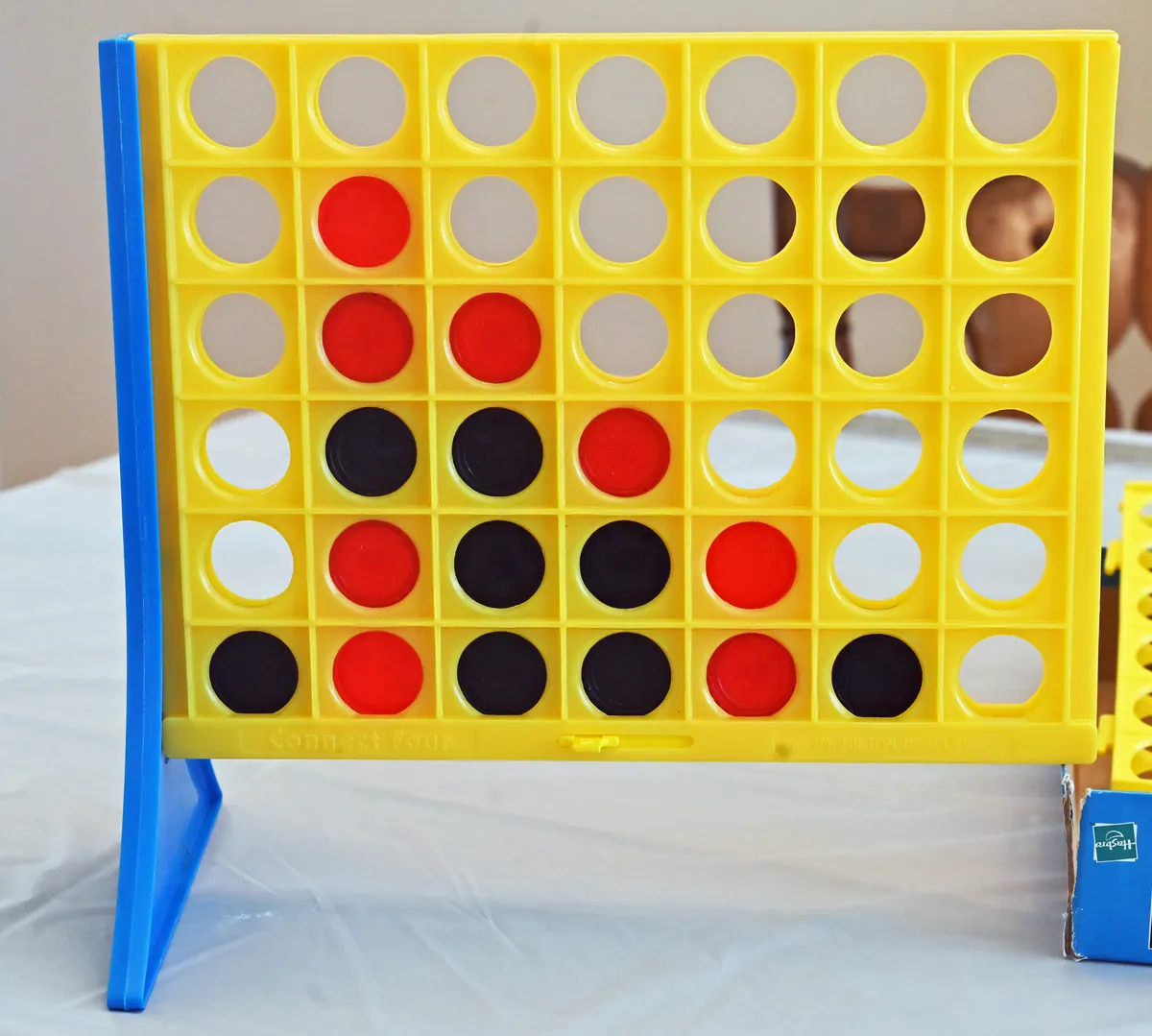
Tap a column and your disc occupies its lowest empty space. A full column is unavailable. Four consecutive discs of your colour win horizontally, vertically or along either diagonal. An empty gap breaks the line, and opposing discs cannot be skipped when counting.
On each turn first look for your own immediate win, then your opponent’s. If they can finish a line with their next drop, you normally need to block that column. If your move already completes four, however, the game ends before they can answer. Winning takes priority over blocking.
Recognise a real double threat
A double threat leaves two distinct, playable winning squares after your move. Your opponent closes one and you use the other. “Playable” is crucial: a square hanging above empty space is not an immediate threat. Track the supporting discs and the new square exposed when another disc falls below it.
The central columns participate in many potential lines, which makes them useful starting points. But playing centrally does not justify overlooking a win at the edge. Check one-move tactics first, then connections between your discs, and only then a longer-term positional plan.
A three-disc line with two open ends
Number columns 1–7 and call the bottom row row 1. Your discs occupy columns 3, 4 and 5 in that row, while squares 2 and 6 are empty and playable. If your opponent has no immediate win, one move cannot save them: blocking column 2 leaves you column 6, and blocking 6 leaves 2.
Compare the same pattern on row 3 when there are empty spaces beneath both winning squares. A single drop cannot reach the required height. This is a potential pattern, rather than a finished fork. Before committing, follow the falling disc all the way down in each candidate column.
Do not provide the winning support
Sometimes your defensive disc becomes the support for an opponent’s winning disc directly above it. Do not stop checking once a horizontal line is blocked: inspect diagonals and the square above your new disc. Another common mistake is building an ambitious line while ignoring an enemy vertical three with a playable fourth square.
Practise in Telegram
Open Four in a Row and play a bot or a friend. Before every drop, identify both players’ immediate wins and the landing square of your intended move. In the next game try creating two threats at the same height. Explain why both squares are playable now; that explanation is the difference between a visual pattern and a working tactic.
Sources and further reading
Another good read
 Puzzles
How to solve Sudoku: singles, hidden singles and steady progress
Learn Sudoku rules, the Number Place story and three practical solving techniques, with a worked example and a simple practice plan.
Read Puzzles
How to play Minesweeper: numbers, flags and safe deductions
Understand the eight neighbours, safe cells and overlapping regions. Includes Minesweeper history and a worked two-clue deduction.
Read Puzzles
How to solve nonograms: overlaps, gaps and picture logic
Learn nonogram history, block rules and the overlap technique with a worked example. Discover why empty cells matter as much as filled ones.
Read