
CHESS / RULES, HISTORY AND STRATEGY
How to solve chess puzzles: checks, captures and threats
A practical method for chess puzzles: choose candidates, calculate the strongest defence and understand a king-and-queen knight fork.

Where the game came from
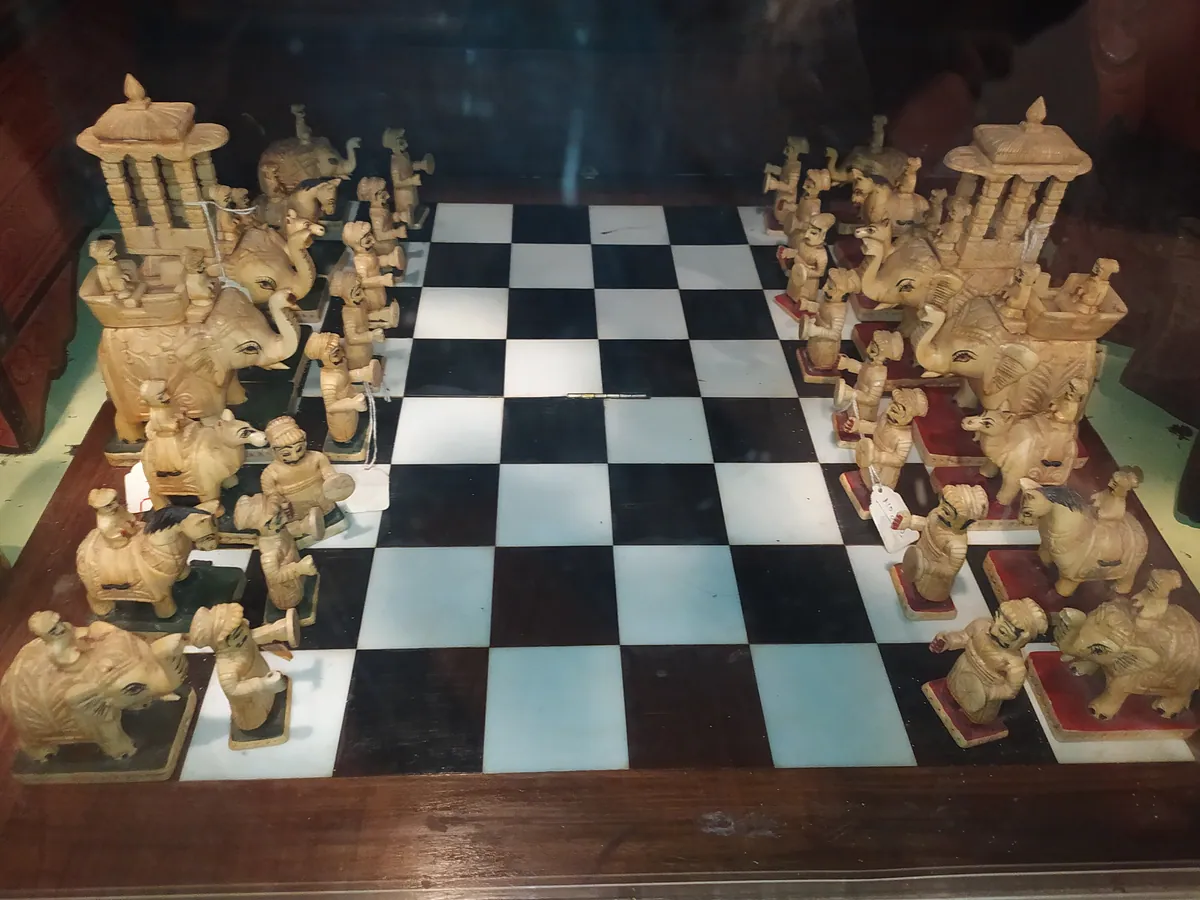
Chess developed from Indian predecessors through Persia and other countries. FIDE connects an early form with chaturanga and the familiar modern game with changes established by the fifteenth century. This is a history of evolving rules rather than one single moment of invention.
A puzzle starts with a position already on the board and asks for an accurate continuation. Rich Games offers puzzles at different levels, a daily puzzle, games against a bot and games with a friend. Alternating short calculations with full games helps connect patterns to practical play.
Loading the practice board…
A puzzle asks for more than an attractive move
In a normal game several plans may be reasonable. In a puzzle you seek a continuation that achieves a particular objective against the best defence. Taking an undefended pawn may miss a forced queen win or checkmate. First read the position: whose turn is it, where are the kings, and what is attacked?
You must answer check and cannot leave your own king attacked. Checkmate means check with no legal escape. Stalemate means no legal move without being in check, and is a draw. The distinction matters when a large material advantage can still be spoiled by one careless move.
Build three groups of candidate moves
List checks first, then captures, then direct threats. This does not mean every check is good; it helps you notice forcing possibilities. For each candidate find the opponent’s most troublesome reply. Do not make their decisions for them by selecting the defence that suits your idea.
Update the whole position after each imagined move. A departing piece opens a rook or bishop line; a removed defender makes a capture possible; a displaced king creates a fork. Calculate a short, accurate sequence until you reach a clear outcome such as mate, a safe material gain or a successful defence.
A worked knight fork
Take this teaching position: White has a king on a1 and knight on f5; Black has a king on g8 and queen on h8. All other squares are empty, and White moves. The knight jumps to e7 with check, attacking g8 and h8 at the same time. The check forces Black to deal with the king’s safety first.
The black king cannot capture the knight on e7 and must leave g8. After a legal king move, White takes the queen with the knight on h8. The order of reasoning matters: establish that the check is real and the knight cannot be captured, then count the gain. Extra pieces in a full position could change the defence.
Do not stop calculating at your own move
Finding an attack does not prove that it works. Check for a countercheck, a capture of the attacking piece or a defence of the more valuable target. Another common mistake is remembering the initial diagram instead of the position after several moves. Remove captured pieces mentally and clear their squares. One accurate line is better than a long, confused sequence.
Build a short training session
Open the chess bot and solve a few puzzles at a comfortable level. Before answering, identify your candidate and the strongest defence. Then play a bot or a friend and look for the same pattern in a full game. Approach the daily puzzle when you have time to calculate, rather than guessing the first tempting move.
Sources and further reading
Another good read
 Puzzles
How to solve Sudoku: singles, hidden singles and steady progress
Learn Sudoku rules, the Number Place story and three practical solving techniques, with a worked example and a simple practice plan.
Read Puzzles
How to play Minesweeper: numbers, flags and safe deductions
Understand the eight neighbours, safe cells and overlapping regions. Includes Minesweeper history and a worked two-clue deduction.
Read Puzzles
How to solve nonograms: overlaps, gaps and picture logic
Learn nonogram history, block rules and the overlap technique with a worked example. Discover why empty cells matter as much as filled ones.
Read