
CHECKERS / RULES, HISTORY AND STRATEGY
How to play Russian draughts: captures, kings and combinations
Learn Russian and casual draughts in Rich Games, including backward captures, complete capture chains and tactical sacrifices.
Where the game came from
Draughts has several national variants. The International Draughts Federation publishes rules for draughts-64, distinguishing Russian and Brazilian versions. Sharing an 8×8 board does not make their rules identical, and ideas from English or American checkers cannot always be transferred unchanged.
Draughts also has a notable computing history: in 1959 Arthur Samuel published research on machine learning using checkers. That concerned another member of the family; it was not a proof that Russian draughts had been solved. In Rich Games, start by choosing Russian or Casual rules.
Loading the practice board…
Understand the two modes
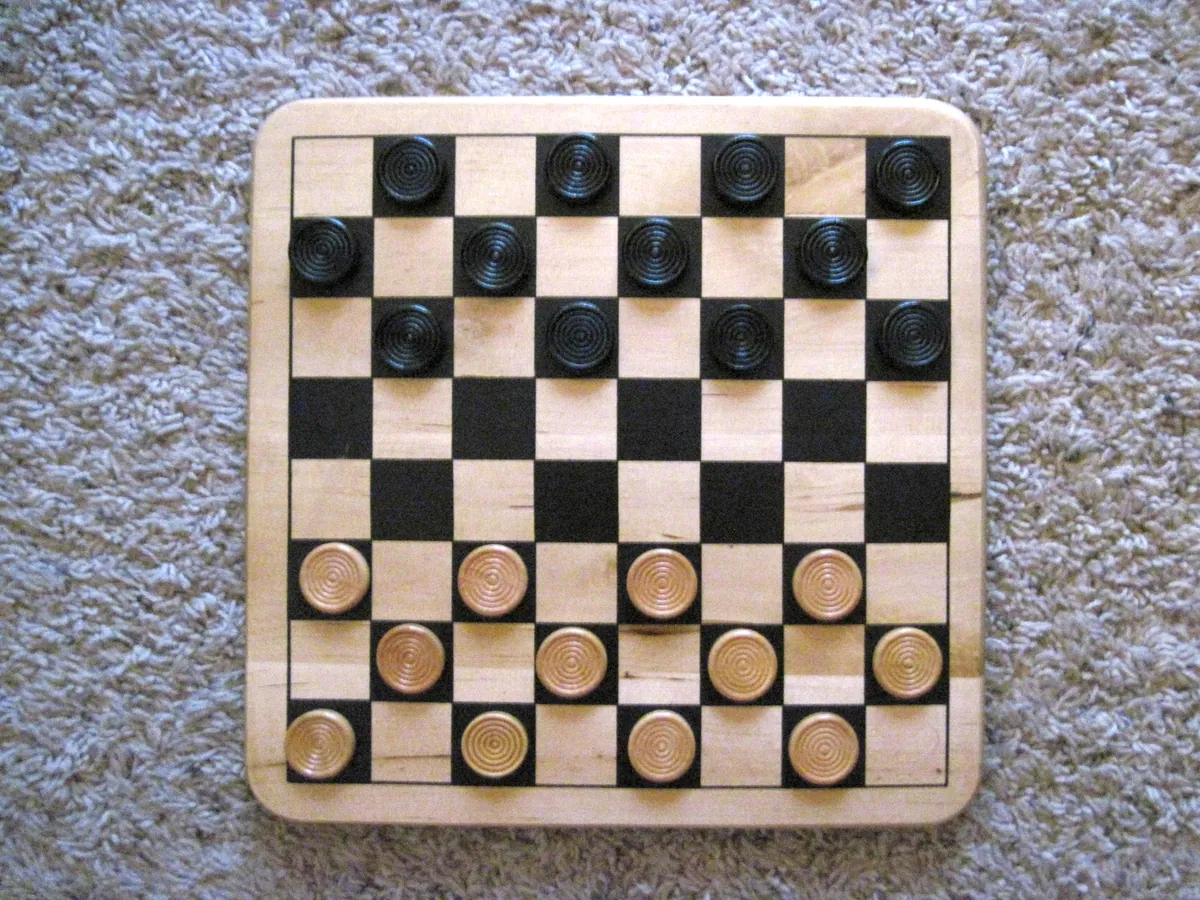
Play takes place on the dark squares. An ordinary man makes a quiet move one diagonal square forward, but may capture both forward and backward. A king travels along an unobstructed diagonal. A man reaching the final rank during a capture becomes a king and continues capturing as a king if another capture is available.
Under Russian rules you must capture when a capture exists, and complete a capture chain once started. Casual mode allows a quiet move even when a capture is possible; a chain can be selected by its final landing square. You win by leaving your opponent with no pieces or no legal moves. Always calculate using the selected mode.
Count the complete exchange
A combination uses forcing replies. Under Russian rules you can offer one man to pull away a defender and capture two in return. Check every capture available to your opponent first: if there is a choice, they can select the continuation least convenient for your plan.
Evaluate the square where your capture chain ends. Your piece may face an immediate reply or be heading towards promotion. A king’s range is powerful, but controlling a long diagonal does not replace calculation. The route must be clear, and every jumped enemy needs a legal landing square beyond it.
An ordinary man can capture backward
In a teaching fragment your man stands on d4, an enemy stands on c3, and b2 is empty. Even if your men normally advance towards the eighth rank, d4:b2 over c3 is legal: Russian men capture backward. If another capture is available from b2, the move is not finished yet.
In Russian mode you cannot choose a quiet move elsewhere while any capture is available. In Casual mode you can. Now add an enemy on c5 and leave b6 empty: d4:b6 becomes an alternative capture direction. Compare both complete chains instead of assuming that the first capture you notice is the only choice.
Compulsory capture is not maximum capture
Russian draughts does not require you to choose the route that captures the largest number of pieces when several routes exist. The route itself is a strategic choice. Do not import the maximum-capture rule from other variants. Nor does promotion immediately settle a combination: your new king might still be vulnerable at the end.
Train the difference in the bot
Play Russian mode against the bot and check both sides’ captures before every move. Then try Casual mode and revisit a sacrifice: does the idea still work if the opponent can refuse it? After a game with a friend, discuss that decision. Learning which replies are forced is more useful than memorising a sacrifice without its conditions.
Sources and further reading
Another good read
 Puzzles
How to solve Sudoku: singles, hidden singles and steady progress
Learn Sudoku rules, the Number Place story and three practical solving techniques, with a worked example and a simple practice plan.
Read Puzzles
How to play Minesweeper: numbers, flags and safe deductions
Understand the eight neighbours, safe cells and overlapping regions. Includes Minesweeper history and a worked two-clue deduction.
Read Puzzles
How to solve nonograms: overlaps, gaps and picture logic
Learn nonogram history, block rules and the overlap technique with a worked example. Discover why empty cells matter as much as filled ones.
Read