
BATTLESHIP / RULES, HISTORY AND STRATEGY
Battleship strategy: search patterns and finishing a damaged ship
Learn the Russian ten-ship fleet on a 10×10 grid, no-touch placement, targeted follow-up shots and the limits of checkerboard searches.
Where the game came from
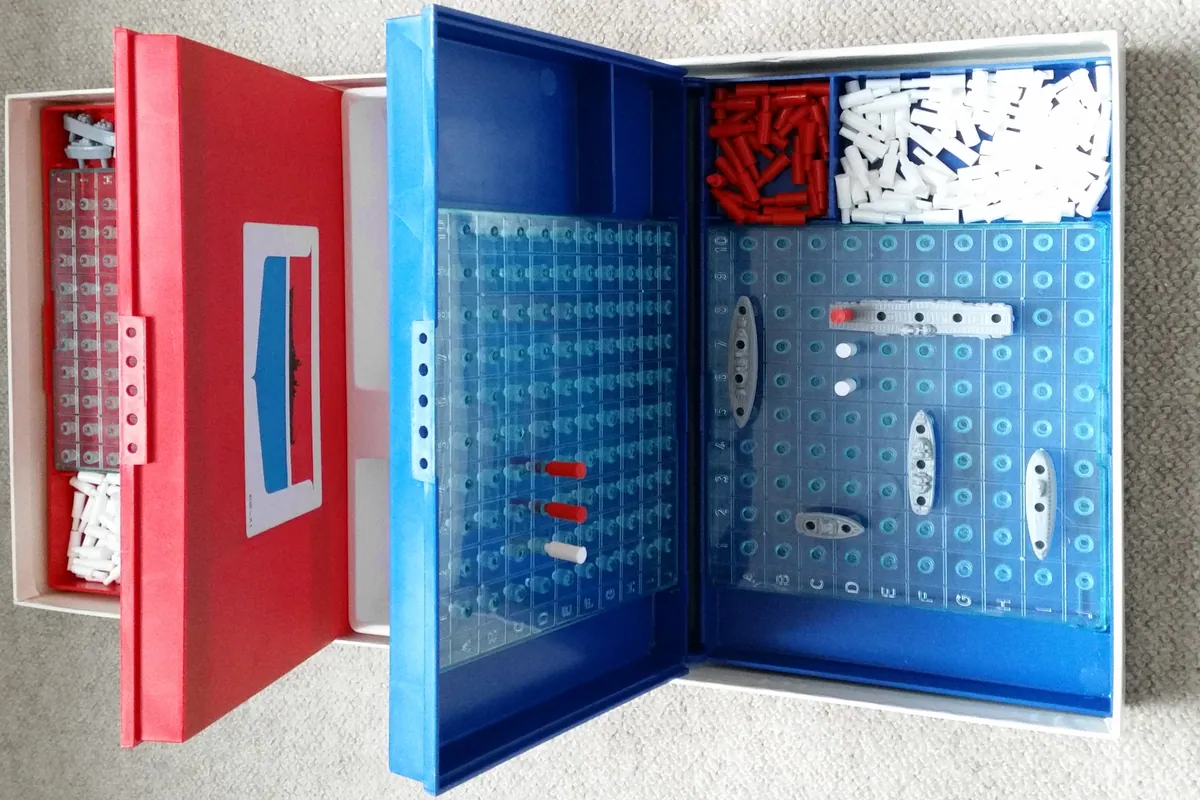
Battleship grew out of games with hidden positions on paper grids. The Strong museum records printed Salvo grids in 1931, the paper game Broadsides in 1943 and Milton Bradley’s plastic Battleship release in 1967. The familiar boxed game is part of the history, rather than the origin of every version.
Fleets and rules differ between editions. Rich Games uses a Russian ten-ship fleet, prohibits ships from touching even diagonally and grants another shot after a hit. Check advice from other editions against these rules before applying it to your game.
Loading the practice board…
Know the fleet
Each player has a 10×10 grid with one four-cell ship, two three-cell ships, three two-cell ships and four single-cell ships: twenty occupied squares in total. Ships are straight, horizontal or vertical, and cannot touch another ship along an edge or at a corner.
A miss passes the turn. A hit lets you shoot again, and sinking a ship marks both the destroyed vessel and the surrounding water. Your objective is to sink the entire enemy fleet. Your own layout remains hidden from your opponent; the My Board section lets you arrange and save it in advance.
Separate searching from finishing
Before finding a ship, search areas where the remaining ship lengths can still fit. Alternating squares like a checkerboard intersects every straight ship at least two cells long, because neighbouring cells alternate colour. It does not cover single-cell ships, which may sit entirely on the skipped colour.
After a hit, examine its horizontal and vertical neighbours. Diagonal cells cannot continue the same straight ship, and the no-touch rule prevents another ship occupying them. Once a second hit establishes a line, follow that line in both directions until the ship sinks or a boundary is known.
Two hits at D5 and E5
Use letters for columns and numbers for rows. You hit D5, then hit E5 with your next shot. The ship must be horizontal. Its continuation may lie at C5 or F5; D4 and E6 cannot belong to it. Once orientation is established, there is no reason to keep spreading your follow-up shots in four directions.
If F5 is water and the ship has not sunk, examine C5. After sinking it, treat the marked water around it as a boundary for further searches. When all ships of length two or more are gone, abandon the habit of skipping half the squares: remaining single-cell ships require every eligible location to be considered.
Why always shooting centrally is insufficient
The centre belongs to many possible long-ship placements, but misses and sunk ships change the useful search area. Do not follow a fixed pattern into spaces where no remaining ship can fit. Uncertainty still remains: the same observations may match several layouts, so no sequence of guesses guarantees victory against every hidden fleet.
A plan for the next game
Arrange your own board or start a game against the bot or a friend. During the search, track the lengths of ships still afloat. After the first hit identify the possible neighbours; after the second establish orientation. Switching deliberately between search and finishing is more useful than repeatedly guessing an opponent’s favourite coordinates.
Sources and further reading
Another good read
 Puzzles
How to solve Sudoku: singles, hidden singles and steady progress
Learn Sudoku rules, the Number Place story and three practical solving techniques, with a worked example and a simple practice plan.
Read Puzzles
How to play Minesweeper: numbers, flags and safe deductions
Understand the eight neighbours, safe cells and overlapping regions. Includes Minesweeper history and a worked two-clue deduction.
Read Puzzles
How to solve nonograms: overlaps, gaps and picture logic
Learn nonogram history, block rules and the overlap technique with a worked example. Discover why empty cells matter as much as filled ones.
Read